 |
| POPULATION AND POLLUTION The informal settlers' houses being compressed alongside waterways of Sta. Mesa, Manila depicts poverty. Some garments and the laundry basins are being hanged on the fences under the coconut tree, which shows that residents contribute to the water pollution after throwing their drained waters from laundry. |
Miyerkules, Enero 29, 2014
POPULATION AND POLLUTION

Miyerkules, Enero 22, 2014
OBEDIENCE: A Safety Guarantee
 |
| Philippine Daily Inquirer January 2014 |
Last year, the Land Transportation Franchising and Regulatory Board (LTFRB) immediately imposed a 30-day preventive suspension on all 78 bus units of the Don Mariano Transit Corp. (DMTC). Then a case hearing on the possible cancellation of the bus franchise of the DMTC had been set on January 7, 2014 (Villanueva, 2013).
Stubbornness seems to rule over again leading to
a recent news about the bus firm (DMTC) that loses its franchise for death of
21. It is now being one of the top alarming flash reports these days.
“The government imposed the ‘heaviest
penalty’ and cancelled the franchise of a 20-year-old bus company over the Dec.
16, 2013, highway accident that killed 21 people and injured 24 others in
Taguig City (Philippine Daily Inquirer, 2014).”
“Around 5 a.m. on Dec. 16, a Don Mariano
Passenger Bus driven by Carmelo Calatcat fell off the elevated Skyway and
crashed onto a closed van below. The company’s entire fleet was placed under
preventive suspension immediately after the accident (Phil. Daily Inquirer,
2014).”
It was then when LTFRB Chair
Winston Ginez said that the board looked into the company’s checkered safety
record, which included a 2012 accident that killed a motorcycle driver on the
northbound lane of Magallanes flyover. The investigation also found that Don
Mariano allowed the first illegal use or change of chassis on its busses
without informing the LTFRB—a clear misinterpretation which this board can never
tolerate (Phil. Daily Inquirer, 2014).
Ginez also stressed that with all
the evidence submitted and gathered, there is no doubt that respondent Don
Mariano has repeatedly failed to comply with the terms and conditions of the
certificates of public convenience granted to it. Moreover, it also failed to
provide services that were “safe, proper and adequate” (Phil. Daily Inquirer,
2014).
What is so hard in obeying rules? To
obey is to simply follow and comply with the rules or directions being set in
order for one to serve as his guide. Well, in some cases, maybe, to obey is
very hard because of pride and lack of self-discipline.I have often heard people blaming
and saying that the blame should go to the government for their negligence and
failure to properly regulate. Road accidents should only be avoided if only
there are conscious efforts about road safety. Of course, that is important.
Road safety is the government’s responsibility. However, nothing would change
if people will keep on blaming the government agencies. Blaming could not
already even return the 21 lives of the victims being killed on the tragic
accident.
It seems that both sides are wrong—the DMTC and the government agencies. The two may be considered as equally liable for the casualties. In the case of the Don Mariano bus mishap, the owners should be made personally liable, not just the bus company. Unless this is done, other bus operators will not get the message that they need to behave and follow the laws (The Philippine Star, 2013).
It seems that both sides are wrong—the DMTC and the government agencies. The two may be considered as equally liable for the casualties. In the case of the Don Mariano bus mishap, the owners should be made personally liable, not just the bus company. Unless this is done, other bus operators will not get the message that they need to behave and follow the laws (The Philippine Star, 2013).
Furthermore, the Skyway management should also be held liable for damages, since that is not the first time a bus or vehicle has jumped off it. There is negligence in the enforcement of traffic safety rules including violation of the speed limit. Government should invest on road safety (The Phil. Star, 2013).
However, I agree with what the government has done to the bus firm. Cancelling the license of a 20-year-old bus company (that is also known for having almost 20 years of being stubborn and noncompliance to LTFRB’s rules and regulations) could only be the best solution for reducing the risk of road accidents. This is for the people to realize and learn from their mistakes. They have just reaped their consequence for being disobedient.
With the so many dilemmas our country is facing nowadays, we should value accountability even in small but terrible happenings like these. It is just like a matter of accepting your own mistakes andkeeping your feet off the ground always. It may be easy for us to blame the bus driver for his disobedience or the government for their late prevention actions; however, looking at a general perspective, the change should start within ourselves. We don’t have to wait for someone to take the action but the initiative for a change is in us. If you’re a responsible citizen of the country, then follow rules and regulations; if you’re a government official, things that matters life and death should be given an ounce of prevention immediately better than cure.
Sources:
Camus, M. and Gamil, J. (2014, January
15). Bus firm loses franchise for death of 21. Philippine Daily Inquirer, p. A23
Villanueva M. (2013, December 20). Look
left and right, then look up, too. The
Philippine Star OPINION, p. 17
Chanco B. (2013, December 20). Who is
responsible for road safety? The
Philippine Star BUSINESS, Retrieved from: http://www.philstar.com/business/2013/12/20/1270051/who-responsible-road-safety
Linggo, Enero 5, 2014
TUNAY NA DIWA NG PASKO (Featuring Orchids Street-- my residential street)
If chivalry is dead, bayanihan is still alive! In this video blog of mine, I just want to impart you the warmth, love and unity that can still be seen nowadays. One good example is our small community to where I live. Enjoy watching!
Do-It-Yourself-Pizza (HANNAH'S RECIPE)
Aside from oatmeal goodies, I am also a big fan of pizza. Here is my own version of making a DO-IT-YOURSELF Pizza. Aside from drawing, writing, singing and scrapbooking, making such food recipes are also my hobbies.
At least I hope you enjoy making one too as you also try to get some of my healthful and budget-saving ideas from my own recipe of pizza!
Happy New Year! May God grant us all a bountiful new year ahead!
Huwebes, Disyembre 26, 2013
WORDS ARE POWERFUL
I
will not forget that one incident during my sixth grade. It was the day when I
first met the world’s meanest person to me. Looking out for a chair to sit on,
I noticed that the one in the middle was empty and so I decided to go on it. I
found everyone in the classroom so amiable and appreciated a ‘transferee’ like
me except for that one. A girl approached to where I was sitting and began to
hit the desk of the chair saying, “Layas!
Ako ang nakaupo diyan!” Terrified by her abruptness, I timidly said ‘sorry’
and was just like a dog lowering down its ears slowly leaving the chair. It was
then when I started to feel something would be going wrong all the way in my
new school. Every time I would be reciting, she would often criticize. Then,
the rest of the class, especially her friends, would laugh with her. I have
always been intimidated by that. Her meanness continued until high school. I could hardly
imagine why she, together with some of her friends, was like that to me. Their
negative responses gradually reduced me into what I perceive myself to be—nothing but a sort of laughing stock. I did not even know if I was
just being too sensitive or it was just her being too nasty.
All
the while I have thought of my personality as something that is negative and unacceptable.
It is generally my high school classmates who brought humiliation to my
character. It is like they are bullying me emotionally. I find this situation
true to the theory of symbolic
interactionism. It is under Max Weber’s assertion that symbolic
interactionism explains
how individuals analyze society (including themselves) by addressing the
subjective meanings that people impose them (Crossman, 2011). Most of my high
school classmates imposed me critics about my personality. Hence, I later become
paranoid with them (and the people around me) because of the harmful
perceptions about myself. This is when my self-concept about my personality
changes. I have perceived in myself that being reserved or mahinhin is something that I should not
be proud of.
With symbolic interactionism, the
concept of the self can be framed. This is where the “looking-glass
self / generalized other,” which is the sum total of responses and expectations
that we pick up from the people around us, is being formed. We naturally give
more weight to the views of significant others (Symbolic
Interactionism, 2013). If in my family and real friends, I can visualize
myself as someone who is loved and acceptable; to my high school classmates, I
can see myself as someone who is hateful and a laughing stock.
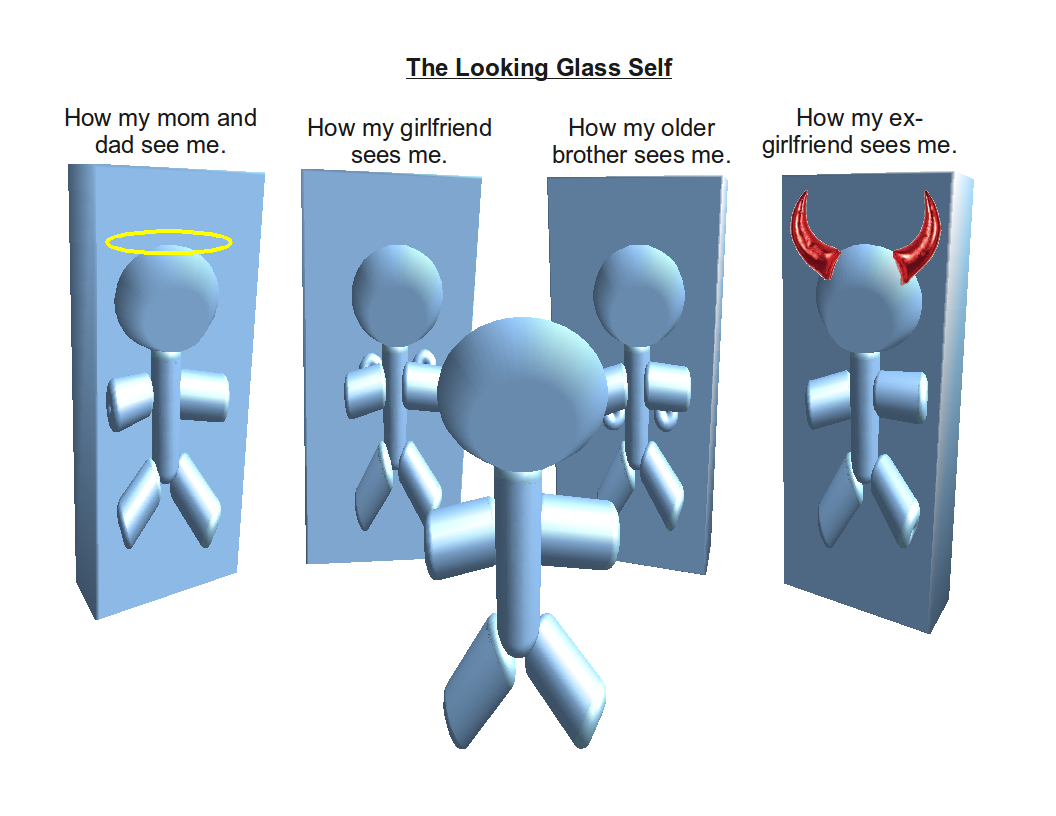
The concept of the “looking glass
self (or generalized other)" argued that the way we think about ourselves
is particularly apt to be a reflection of other people's appraisals and that
our self-concepts are built up in the primary groups. (Cooley, 2013).
Self-concept is the image we have of who and what we
are (formed in childhood by how significant others treat/respond to us). The self-concept is not fixed and
unchanging (LaRossa & Reitzes, 1993). I am elated and totally agree with
this notion. If my self-concept during my high school days is something what I
perceive myself to be—nothing but a
sort of a laughing stock; my self-concept now is much more confident and
optimistic. This is the reason why I got interested in the symbolic
interactionism theory. I am grateful and
can relate much of my character development to this principle. Criticisms have
made me much stronger to be able to withstand not only painful words I
encounter but to go on with life as well despite of how incessant we may be
able to encounter them.
SOURCES:
Crossman, Ashley.
(2011). Symbolic Interaction Theory An Overview. Retrieved December 22, 2013,
from: http://sociology.about.com/od/Sociological-Theory/a/Symbolic-Interaction-Theory.htm
(Symbolic
Interactionism, 2013) Univeristy of Twente. (2013, November 26). Symbolic Interactionism.
Retrieved December 22, 2013, from: http://www.utwente.nl/cw/theorieenoverzicht/theory%20clusters/interpersonal%20communication%20and%20relations/symbolic_interactionism/
The Looking
Glass Self (Photograph). Retrieved December 22, 2013, from: https://www.boundless.com/sociology/understanding-sociology/the-theoretical-perspectives-in-sociology/the-symbolic-interactionist-perspective/
(Cooley,
2013). Symbolic Interactionism. Retrieved December 23, 2013, from: http://www.d.umn.edu/~bmork/2306/Theories/BAMsymint.htm
(LaRossa & Reitzes, 1993). Symbolic Interactionism Theory
(adapted from Scott, Plunkett’s Course Pack). Retrieved December 23, 2013, from:
http://www.csun.edu/~whw2380/542/Symbolic%20Interactionism%20Lecture.htm
Martes, Disyembre 17, 2013
ROOT OF A PARTIAL "ME"
A
person’s character is influenced by several factors. The environment and the
genetics are the two major dominant influencers. I believe that what I am now
is a product of my experiences—and that falls under the environmental factors
that influenced my identity aside from the traits I have gotten genetically
from my parents.
Social
interactions have to do a lot in the development of a person’s character. “No
man is an island” as the saying goes. The social communication that exists in a
person’s experiences may contribute a lot to one’s molded identity.
Symbolic Interactionism is formulated by Blumer (1969), a
student of George Herbert Mead at the University of California whose key ideas
of such theory originated. It is the process of interaction in the formation of
meanings for individuals. The inspiration for this theory came from Dewey
(1981), which believed that human beings are best understood in a practical,
interactive relation to their environment. The theory consists of three core
principles: meaning, language and thought. These core principles lead to
conclusions about the creation of a person’s self and socialization into a
larger community (Griffin, 1997).
·
Meaning states that humans act toward
people and things according to the meanings that give to those people or
things. Symbolic Interactionism holds the principal of meaning to be the
central aspect of human behavior.
·
Language gives humans a means by which to
negotiate meaning through symbols. Humans identify meaning in speech acts with
others.
·
Thought modifies each individual’s
interpretation of symbols. Thought is a mental conversation that requires
different points of view.
With these three
elements the concept of the self can be framed. People use
‘the looking-glass self’: they take the role of the other, imagining how we
look to another person. The self is a function of language, without talk there
would be no self-concept. People are
part of a community, where our generalized
other is the sum total of responses and expectations that we pick up from
the people around us. We naturally give more weight to the views of significant
others.
As I have
mentioned a while ago social interactions have to do a lot in one’s
personality. One’s self-concept and ‘generalized other’ are being affected as
we tend to have social relationships with other people particularly in the
community we are currently living to. Symbolic
interactionism is the way we learn to interpret and give meaning to the world
through our interactions with others.
THE SELF: Reflections in a
looking glass
Self-concept
is developed through the process of interaction and communication with others.
It is shaped by the reactions of significant others and by our perceptions of
their reactions. Once developed, it provides an important motive for behavior (LaRossa &
Reitzes, 1993).
Moreover, it is also
the image we have of who and what we are (formed in childhood by how
significant others treat/respond to us). It is not fixed and unchanging—in my
childhood years, my teachers tell me that I am naughty and talkative, but later
in my life, I have developed my quietness when I was enrolled in a school
wherein silence and self-discipline is strictly portrayed besides my mother
have scolded me to do so. It was then my self-concept has been changed which
probably could have led to my modest behavior.
COMMUNITY: The Socializing Effect
of Others’ Expectations
Mead
dismissed the idea that we could get glimpses of who we are through
introspection. Symbolic interactionists are convinced that the self is a
function of language. Without talk, there would be no self-concept, so one has
to be a member of the community before consciousness of self sets in. The self
is an ongoing process combining the “I” and the “me”. The “I” is the
spontaneous driving force that fosters all that is novel, unpredictable and
unorganized in the self. The “me” however is viewed as an object—the image of
self seen in the looking glass of other people’s reactions (Griffin, 1997).
The term “generalized
other” is a synonym for the “me”. The “me” is formed
by those who surround you.
The generalized other shapes how we
think and interact within a community. It is the sum total of responses and
expectations that we pick up from the people around us. We naturally give more
weight to the views of significant others.
The
generalized other is an organized set of information about what the general
expectations and attitudes of a social group are. We refer to this whenever we
try to behave or try to evaluate our behavior in a social situation. We take
the position of the generalized other and assign meaning to ourselves and our
actions. To summarize, there is no “me” at birth.
The “me” is formed only through continual symbolic interaction—first with family,
next with playmates, then in institutions like schools (Griffin, 1997).
The symbolic
interactionism theory, I think, has a lot to do with my character—the totality
of what comprises myself as a person. My experiences has molded a partial
(although not a hundred percent) of me as to what I am now. My self-concept of
today probably has become much more optimistic compared to my former
experiences. Let me share to you a glimpse of what I have experienced during my
late grade school and early high school days. It has to do with Mead’s concept
of generalized other.
I
will not forget that one incident during my sixth grade. It was the day when I
first met the world’s meanest person to me. I was a transferee then. Looking
out for a chair to sit on, I noticed that the one in the middle was empty and
so I decided to go on it. I found everyone in the classroom so amiable and
appreciated a ‘newbie’ like me except for that one. A girl with a name that starts with the letter "K" approached to where I was sitting and began to hit the desk of the chair
saying something offensive. Terrified
by her abruptness, I timidly said ‘sorry’ and was just like a dog lowering down
its ears slowly leaving the chair. It was then when I started to feel that
something would be going wrong all the way in my new school to where I was
enrolled. I have already hated that girl the very first time I saw her. I was
certainly sure that the feeling was just mutual. Every time I would be
reciting, she would often criticize. Then, the rest of the class, especially
her friends, would laugh with her. I have often been intimidated by that.
Her meanness continued until high school. I could hardly imagine why she, together
with some of her friends, was like that to me. Their negative responses
gradually reduced me into what I perceive myself to be—nothing but a sort of
laughing stock.
I was emotionally hurt every day. I did not even know if I was just being
too sensitive or it was just her being too nasty.
I associated the way my mean high school classmates,
together with that girl with-a-name-that-starts-with-the-letter "K", treat and laugh at me to my personality. Probably because
of my personality that made them hate me. As you’ve noticed their generalized
other has shaped how I think and interact within my community.
However, I have later on learned the importance of
acceptance of oneself. We may later on learn in life that we cannot really
please everybody. Just be brave in the pursuit of your dreams.
Sources:
(Griffin,
1997) http://www.utwente.nl/cw/theorieenoverzicht/theory%20clusters/interpersonal%20communication%20and%20relations/symbolic_interactionism/
The Glaring Facts. Symbolic Interactionism—George Herbert Mead.
Retrieved December 17, 2013. Retrieved from http://www.theglaringfacts.com/communications/comm-theories/symbolic-interactionism-george-herbert-mead/
Huwebes, Disyembre 5, 2013
FEAR IS THE OPPOSITE OF FAITH
Good morning my blog!
Whew! It's another day again. Pressures are striking me. The ticking of the clock is quite moving too fast. Deadlines are arriving... But, I can see the beautiful sunrise of the sun outside the window. Probably, that gives me hope. That is when I have unconsciously uttered "Thank you Lord for this another day!"
Fear is the opposite of faith... Fear is the opposite of faith... This set of words repeatedly comes into my mind even when I was asleep. I don't know why. Maybe because I have been to anxious about lots of things. I want my heart to absorb those words--that when you have faith that all your needs will be met in perfect timing in the perfect way, there's no reason to feel afraid. But how could I be able to practice it? Hmm... Pray! Just a prayer may do I think. Probably I need to meditate on Bible and read Chuck Swindoll's Growing Strong in the Seasons of Life later on. Having such inspires me somehow.
But... something really bothers me. Honestly, I am still sleepy even though I just have an eight-hour of sleep or less I think. Probably, that's because I haven't had a continuous sleep. Paputol-putol kung baga ang tulog ko. Actually, I have been feeling a hunger even in my dreams. Oh! I remember last night that I have just eaten only chicken pie and milk as my dinner. I was not feeling well that night so I have not been able to eat rice. They would say that I need to gain some weight because I have been too skinny. My weight is not proportion to my height. My body mass index has been categorized as underweight. Hey! That's one fear of mine I need to overcome--the fear of being fat. That could be phagobphobia. When one is phagophobic, he/she is afraid to swallow his/her food because of his/her fear of being fat. I have been chubby during my high school days and so I have been very conscious about my weight. Well, anyway, that is past and I want to forget that past. I need to focus on the present. Fear is the opposite of faith! Probably I just need acceptance of myself. There's nothing wrong about being fat. They say that I am actually not that fat but I just need my weight to be proportioned with my height. Everyone is unique and has his/her own distinct beauty. Acceptance is the key. Wait. I am feeling very hungry now. I think I need to say goodbye and see you as I write a slice of my life here again!
Mag-subscribe sa:
Mga Post (Atom)